This is a test we ran on real content. Our sister site choose.place publishes day-by-day travel guides: a few thousand words each, dozens of photos, opening hours and prices checked by hand. The question was simple. If a guide already exists as data, how close can an automated pipeline get to a magazine a designer would be happy with?
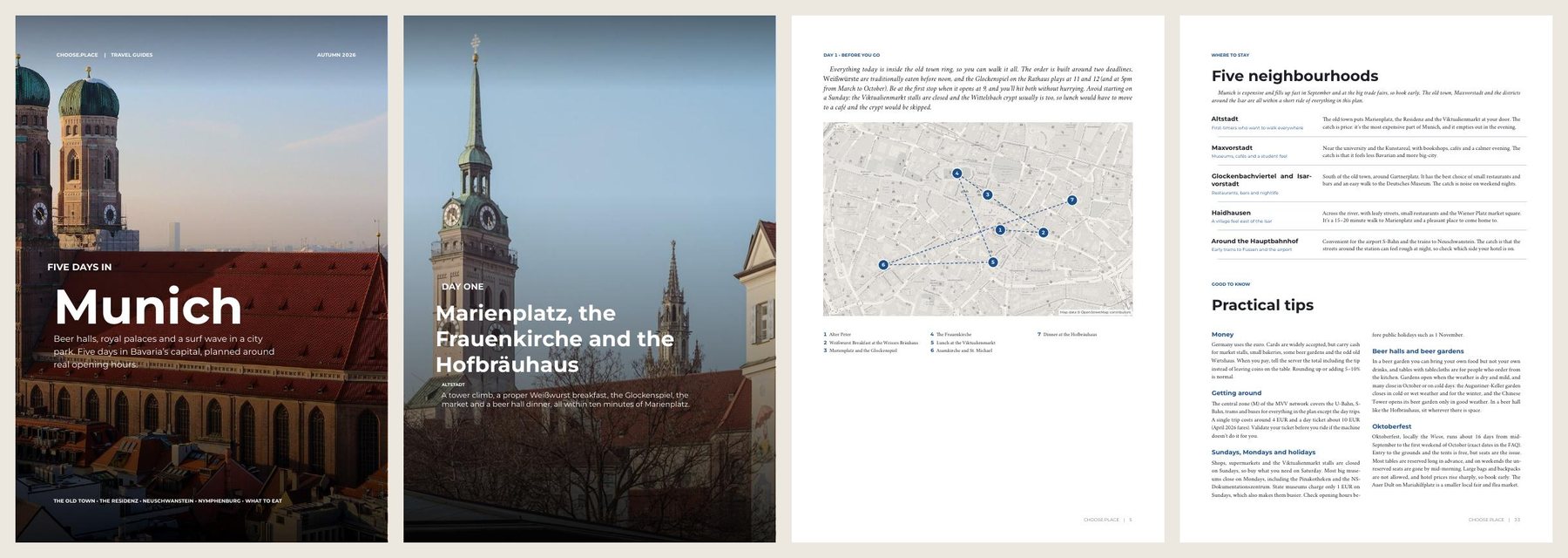
The answer is the 36-page Munich magazine above. It has a full-bleed cover, an opener page for each of the five days, a map of every day with numbered stops, stories set in two columns, a food section, practical tips and a page of photo credits. Nobody laid out a single page by hand.
The input is data, not a document
Each guide on choose.place is one structured file. A day has a title, an area and an introduction; each stop has a name, the time of day, how long it takes, what it costs, its coordinates, a photo and a few paragraphs of text, sometimes with a tip. The guide itself never mentions pages, columns or fonts, which is exactly what makes it useful here: the same file feeds the website, and now a print layout too.
- name: "Alter Peter"
  kind: see
  time: morning
  coordinates: [48.1365, 11.5760]
  duration: "45 minutes"
  cost: "Tower 5 EUR, church free"
  text: |
    Start with the view, before the crowds. St. Peter's is the oldest...
From data to pages
A short script reads the guide and writes the document: a cover from the hero photo, a contents page, a welcome page with the essentials, and then each day in turn. It does not place anything by coordinates on a page. It describes the structure, an opener here, a map there, a stop with a photo and two columns of text, and leaves the rest to the typesetting engine behind Pressa: where each page breaks, how the columns balance, how a photo is cropped to its frame and how a heading is kept with the text that follows it.
To keep the pages from looking like a template repeated thirty times, the stops alternate between two layouts, a photo across the page and a photo set into the first column. That one rule is most of the difference between a report and a magazine.
A map for every day
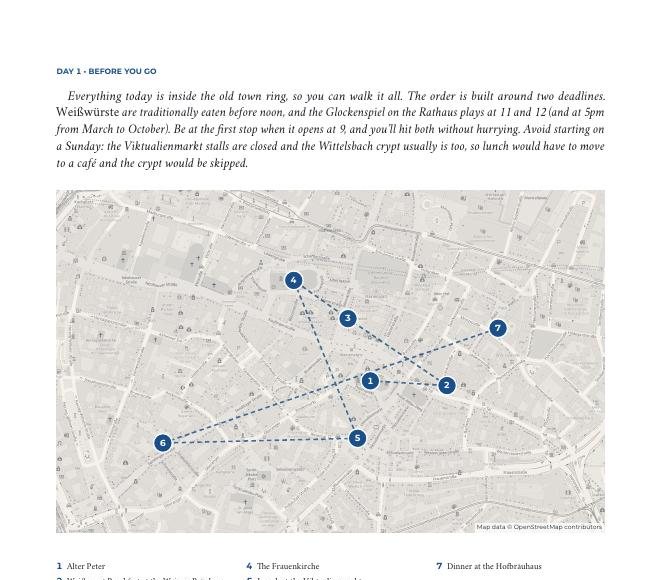
The guide already knew where every stop is. Each day gets a quiet, toned-down map of exactly the area it covers, with the stops numbered in the order you visit them and joined by a dashed line. The same numbers sit next to each stop's heading further on, so the map and the text read together. This is the part a hand-made layout rarely bothers with, and it came almost for free because the coordinates were already in the data.
The numbers
- 36 pages, 42 photos and 5 maps.
- One compile of about 3 seconds.
- Re-run it after the guide is updated and the magazine follows, with nothing to re-flow by hand.
Where a designer still wins
Honesty matters more than the demo, so here is what the pipeline does not do. It follows rules, not taste: a designer would see that one photo is spectacular and give it a whole spread, while the script gives every stop the same treatment. The photos come from the website, sized for screens, so the PDF looks sharp on a display but would need the full-resolution originals for print. And the typesetting runs in a single pass, so the contents page lists what is inside instead of page numbers.
None of these is a limit of the approach. Better photos are a matter of sending better files, and the choice of layout per photo can be handed to an AI agent that looks at the images and decides which deserve the space.
What this means if your content is data
Product catalogs, property brochures, event programs, course books, annual reports: a lot of print-quality material starts life as rows in a database or entries in a CMS. When the content already has structure, the layout can be generated from it, consistently and in seconds, every time the content changes. That is the job Pressa is built for, as infrastructure behind your own system. The API takes the generated source and returns the PDF, and the examples page has the magazine to download.
The photos in the magazine are from Wikimedia Commons, credited on its last page, and the maps use OpenStreetMap data. The guide's text and research are by choose.place.